Showing posts with label Jess Mainwaring. Show all posts

Sunday, 3 May 2015

Jess' Evaluation - Question 1

1. In what ways does your media product use, develop or challenge forms and conventions of real media products?


  • Our thriller sequence 'Omniscient' uses various elements to develop and challenge forms and conventions of real media products through the technical codes; mise en scene, sound, editing, and camera work. We also thought about iconography - such as the gun, restricted narration, binary oppositions, ect. The main aim we had when producing our thriller sequence was for elements in the story to remain unknown, creating irony as the title is 'Omniscient'. We met our aim by using restricted narration,  keeping the character on the other side of the phone call a secret, and through the use of shared context between the characters as the spectator doesn't know the background story of who the person on the phone has taken, and why.  


This is the gun used by the protagonist in our thriller sequence. It is iconography used frequently in many thrillers as it creates enigma. It also gains an immediate reaction from the audience as so familiar to them from it's stereotypical use in various thriller film. However, we tried to challenge conventions of real media products by using a sound bridge of the gun shot, rather then the spectator seeing the gun being shot and whose shooting it.


This shot was inspired by 'Zodiac', because it created such an intense scene full of enigma. However, we challenged this by having the end of the rifle pointed towards the camera, so that it was closer in the frame giving the sense that its pointed at the spectator, whereas in the screen grab from 'Zodiac', the gun is further away meaning there's less of it in the frame.


  • Similarly to the thriller 'Zodiac', our thriller sequence also had a scene of a POV shot from inside a car window driving past houses. This creates enigma for the spectator as you can't see who is in the car (restricted narration) and whether they're an antagonist/protagonist. However, the lighting at this scene in 'Zodiac' is very dark and mysterious which is suitable iconography for a thriller; whereas in our thriller sequence the lighting is dull and faded as opposed to dark - which adds mystery.


  • Enigma is created through other technical codes such as sound. We used a non-diegetic soundtrack to accompany the sequence which started slow in pace and accelerated as it builds up as the sequence begins; creating suspense, unlike other thrillers I researched such as Seven. In the thriller Seven, the non-diegetic use of music is very creepy and intense. We also used a sound bridge when the male character, the antagonist, gets an unknown phone call. By using the sound bridge , enigma is created because the spectator isn't aware of who is on the other side of the phone call.
Image result for seven film


  • Enigma is also portrayed through the introduction of the protagonist. The identity of the protagonist isn't fully known, due to the lighting. This creates spectator positioning because it causes the spectator to wonder who the character is, what their purpose is and whether their the antagonist or protagonist. However, we used mise en scene and iconography for a thriller to hint to the audience that the character is the protagonist. The spectator can see that he is male - male protagonist's are highly popular amongst thriller films therefore it fits the stereotype. The setting is very dark, with minimal colour and the lighting is being presented from a low angle on to the bottom of the protagonists face in order for the outline of his face to be visible - conveying a mysterious, eerie atmosphere. Also, the protagonist is smoking which is iconography often associated with protagonists in the thriller genre.  


  • Restricted narration is used in our main task, something used in many thriller films. We used this to mask the true identity of the protagonist in order to create enigma and spectator positioning. The screen grabs below show how we used restricted narration, and how it was used in 'The Usual Suspects'. We used the rifle (prop) to hide the face of the protagonist whereas in 'The Usual Suspect' they used composition, only showing the bottom half of the character in the frame. 


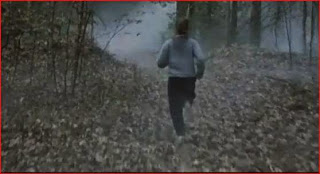
  • I researched the thriller opening to 'Silence of the Lambs' which has a similar setting as Omniscient - a forest. The scene in our thriller sequence where the antagonist is running in the forest through the trees is fairly similar to a scene in 'Silence of the Lambs'. I felt that this scene is full of suspense and leaves the spectator drawn to the scene, therefore wanted to incorporate it in our thriller. 


Saturday, 2 May 2015

Jess' Evaluation - Question 7

7. Looking back at your preliminary task, what do you feel you have learned in the progression from it to the full product?


We have progressed a lot since the preliminary task, and this shows in our main task. We have developed a lot with our use of technical skills:
  • We didn't set the white balance in our preliminary task however in our main thriller task we did which made a huge impact to the quality of the sequence. As you can see from the screen grabs, the second one taken from the main task is a lot clearer and therefore more advanced. The white balance is highly important because it enhances the colors, making it look more appealing to the audience. Without the white balance, the quality of the sequence is poor and has a blue/yellow tint instead of it being white. Also, it could potentially ruin a picture as it adds unwanted colour casts and causes skin tones to look very unnatural. 


  • We incorporated titling into our main task which is a progression from the preliminary task because it's highly important in the film industry to use titles as it displays the production company. The appearance of our titling is suitable for a thriller as it appears on a black screen, and black is an ideal color and iconography to appear in thrillers. However, the black screen cuts to a background imagine of a POV shot from inside a car, watching everything go past from the car window.


  • In terms of sound, there has been a massive progression from the preliminary task to the main task. In the preliminary, we relied on background sound without any form of non-diegetic sound; only dialogue which was recorded at the time of filming. This worked poorly as there was a constant noise in the background which took attention away from the filming. In the main task, we used a soundtrack fitting to the thriller sequence, and it worked really well as it starts with a slow pace and sounds fairly peaceful yet suspenseful. The dialogue is a lot clearer and effective in the main task than the preliminary as it was recorded separating to the filming and added in post-production, therefore there is no background sound like with the preliminary task. We also experienced with foley sounds in the main task such as the diegetic sound of the phones ringtone, and the gun shot. This increases the sound to add effect; which we didn't use in the preliminary task. This shows that our knowledge and confidence in experiencing with different elements such as editing and sound has increased since the preliminary task. 
  • Our preliminary task lacked a lot of editing techniques. We did no editing in post-production, only the use of cuts when putting the shots together. Although we incorporated continuity editing in the preliminary task, they were very basic. However, now our skills have advanced and the use of shot reverse shot, match on action and other continuity techniques used in our main task flow a lot better as a sequence. We also experimented with other editing techniques such as a sound bridge. We incorporated this into our thriller sequence when the antagonist receives a phone call, in order to create enigma.

  • Also, in our preliminary task the camera work was very basic and in many scenes, the camera isn't steady as they were hand-held shots. This massively reduces the quality of the sequence as when you're watching, the camera shakes, resulting in the spectator losing concentration. However, in our main task the camera is very still therefore the shots flow together very well and give an effective performance. In the main task there is a lot more variety of shot sizes and angles to create a more successful and interesting thriller whereas in the preliminary task there were only a couple of CU's, a ELS and every other shot was mostly MS. Aswell as shot sizes, we expanded our use of camera movements such a panning shots (as shown with the car in the screen grabs) and camera angles (as shown in the screen grabs - high angle, eye level). 


  • When planning for the preliminary task, we were highly unprepared in terms of costume, location and lighting. When filming the preliminary, we were unorganized therefore we wore our normal, everyday clothes and didn't think about how other costumes would help construct the story line, or conventions of a thriller. However, in our main task we thought more deeply about the characters role and purpose in the sequence, therefore we chose appropriate clothes which we thought would suit an antagonist/protagonist. For example, a long beige coat and a smart hat says a lot more about a character than jeans and a jumper. It allows you to make assumptions about the characters occupation, social class, ect.


  • In terms of location, we were very restricted as to where we could film on the preliminary task as it had to be on college grounds, therefore the main task was immediately better in the sense that we could venture out and choose a location to film our thriller sequence in as long as we had permission for the premises. This enabled us to be creative and experiment with locations, and in the end we chose a stereotypical location, a popular setting for many thrillers - a forest. This setting worked extremely well as it is very open and free therefore the scene with the car driving along the hill worked extremely well. The scene where the antagonist is running also worked well in this particular location as it has many trees to hide behind and run to. This creates enigma and suspense for the spectator as they're unaware who the antagonist is running from, especially with the non-diegetic music accompanying it. When filming our preliminary task were very unprepared as we weren't able to use our original location due to a class being taught in there, therefore we overcame this by choosing a different room to film in which would have a different effect than the original room, as that was more dark with various lighting.


  • With the lighting, in the preliminary task we relied on the light from the ceiling in the small room that we filmed in, adding no additional light for effect and to increase the quality of the film. However, for our main task we experienced with lighting a lot more and increased our knowledge and techniques on how to use lighting. This improved our main task a lot as we were able to achieve different lighting to match different scenes, whereas in our preliminary task we used the same amount of lighting through-out. This is shown in the first scene which is the introduction of the protagonist, where natural dark lighting is used with staged lighting to help the outline of his face to show. For a majority of the main task, we used natural lighting as it is filmed outside, and we discussed which time of the day would be the most efficient to film in regards to lighting. 


  • We also incorporated the continuity editing technique parallel cutting in Omniscient, whereas in our preliminary task all scenes were shot in one place, in one situation. This shows that events are happening simultaneously and creates engima and suspense. 


Friday, 20 March 2015

Thriller Soundtrack

The Hills Have Eyes is a thriller about a suburban American family that are being stalked by a group of psychotic people who live in the desert, far away from civilization. The clip above is the soundtrack for this film. The soundtrack is striking as soon as it plays, as it is very deep and suspenseful, however as it continues it gets deeper and louder. It then begins to play a softer track in the background, which compliments the deep one. This soundtrack has a very evil, dark feel to it and works very well.


The soundtrack for Final Destination creates a highly creepy atmosphere. It builds enigma and suspense as it is very deep however some elements are high - sounding like a violin. It picks up volume and gathers pace as it progresses, adding to the creep factor. 

Thriller Soundtrack


The Hills Have Eyes is a thriller about a suburban American family that are being stalked by a group of psychotic people who live in the desert, far away from civilization. The clip above is the soundtrack for this film. The soundtrack is striking as soon as it plays, as it is very deep and suspenseful, however as it continues it gets deeper and louder. It then begins to play a softer track in the background, which compliments the deep one. This soundtrack has a very evil, dark feel to it and works very well.


The soundtrack for Final Destination creates a highly creepy atmosphere. It builds enigma and suspense as it is very deep however some elements are high - sounding like a violin. It picks up volume and gathers pace as it progresses, adding to the creep factor. 


Friday, 6 March 2015

Thriller titles

For our thriller, we need a suitable title which will be presented in our opening. The title needs to be appropriate for our thriller opening, suiting the purpose and audience. Therefore, I have researched titles from other thrillers to get ideas for ours.


The titles above are particularly effective because the first one is a reflective image, and the second is overlapping. They're both of dark coloring which suits the thriller genre. Titles like these work really well in thriller openings because they look mysterious - like they're meant for a thriller, which builds to the enigma.

Research


Pulp Fiction

The credits appear with a background of two characters, one female and one male. The female characters facial expression looks very angry, and both of the characters are pointing a gun to something/someone which can't be seen in the frame. This constructs the thriller genre because the gun is suitable iconography for a thriller, and it creates anticipation for the spectator, creating enigma and also suggests something of what the film is about. Institutional information is presented in yellow text, which catches the spectators attention easily. The font is very rounded rather than sharp edged, which doesn't clearly demonstrate a thriller atmosphere however it suits the non-diegetic music which gives a feel of adrenaline.


The series of credits leading up to the titles are displayed on a black screen, which demonstrates the thriller genre and gives a spooky feel.


The title slowly rises into the frame, and then stops in the frame, covering all of it. The bold, big text is displayed on top of a black screen and the font looks 3D.


Panic Room

The credits appear on top of an establishing shot, this gives us an insight on where the film is set. The font of the institutional information is white and small in the centre of the frame.


The scene cuts to another establishing shots, with more credits being displayed however from a different angle. The font looks as if it is coming out of the frame in comparison to the background image, giving a mysterious look. Non-diegetic music is playing through-out the credits which sounds like it is building up to something, creating enigma. Also, there is diegetic sound of car horns, and various other sounds coming from the background.


The shots cut to different credits, all with an establishing shot background. where the font varies in size and angles. There is a panning shot where the credits pan into the frame.


The title pans into the frame over an establishing shot of buildings. The font of the title reflects in the building in the background image, this demonstrates the thriller genre because it is mysterious. The non-diegetic music deepens at the title enters the frame, and the font is bold and larger than the previous titles.


The Lovely Bones

The sequence starts with the introduction of a female character and a male character. It is a father and daughter, and they don't demonstrate the thriller genre. There is a non-diegetic voice over commentary from the female character, however also diegetic sound of the father talking to his young child. The title appears faded in the snow globe, however it becomes more easy to see and bolder. The font is in capitals and is white, therefore it blends in with the snow well. Non-diegetic music plays as the titles appear, which sounds mysterious and gives an eerie feel. There is also diegetic sound of the snow hitting the edge of the glass globe. There is no institutional information.


Tuesday, 3 March 2015

Animatic 2

This animatic is a voice-over commentary of our thriller opening. In this animatic, there's a detailed explanation of each shot and how it will link to the next in order to make this a successful opening. Aspects of mise en scene are explained for each shot such as composition, makeup, ect. Also, we have introduced continuity editing into our opening. 

Friday, 27 February 2015

Thriller Filming Locaction

The location that we will be filming in is a forest in Cuckfield, which we have access to as it is near Josh's house. We also have permission for the car we are using in our filming.

Animatic


This is our storyboard anmatic for our thriller opening. It is a brief outline of the story, including the duration of the shots and shot sizes.

Tuesday, 10 February 2015

Story Idea

The opening begins with an establishing shot of the forest, with dark lighting from a high angle. The scene cuts to the antagonist stumbling out of the forest, wounded and covered in blood. His clothing will be torn, covered in mud and he will be shirtless. He will be carrying a weapon to cause spectator positioning as it won't be clear whether he is the antagonist or protagonist. He will be heavy breathing (sound bridge) and out of breath as he has just been chased by the protagonists. He walks up to a car, limping and tired as he is wounded. The scene cuts to a shot of the protagonist at a window with a sniper aimed at the antagonist in the car outside, we don't see the protagonist's face (restricted narration). He drives it slowly up a hill before the engine dies. Then it cuts back to the protagonist at the window. He starts to get angry and begins to hit the car. The scene cuts again to the protagonist at the window. He then opens the car door and he falls out of the car before slowly dragging himself back up. Then there's a cut to the titles with scary non-diegetic sound of music. The next shot is of a new character (detective) waking up, eating breakfast, getting ready, then driving to the crime scene. Then it cuts to him in the interrogation room interviewing a potential protagonist.

Tuesday, 3 February 2015

Pre-Production Planning

Setting - Forest
Props - Gun, fake blood (corn syrup, food colouring), vaseline, tissues, car, fake cuts (wax, paint, moisturizer, foundation)


Lighting and color - darkish
Composition - restricted narration
Creation of character -
Antagonist:
  • Costume: shirtless, muddy jeans with holes in, trainers 
  • Hair: scruffy 
  • Make-up: blood, fake wounds 
  • Body language: slouched over
  • Facial expression: fearful, exhausted.
  • The antagonist is first shown stumbling out the forest. He has been running away from the protagonist as he was being hunted however we don't see this. He is wounded, covered in blood and has been weakened. His clothes are muddy and torn as he has fallen over, and he is lacking energy to run further. His hair is very scruffy and messy, and his body language is slumped over. In the close ups of his face he appears to look very panicked and exhausted, constantly looking over his shoulder and wary of his surroundings.   
Protagonist:
  • Costume: unseen (restricted narration)
  • Hair: dark, hat covering his eyes
  • Make-up: none
  • Body language: holding a gun
  • Facial expression: unseen
    The protagonist is only seen from behind, with a gun aimed at the antagonist. There is use of restricted narration as we don't see the protagonists face, and it is CU, therefore you can only see the back of his head and his shoulders - he is wearing a hat. He is pointing the gun out the window to the antagonist.   
Detective:
  • Costume: dark, smart clothing, long black jacket, badge, hat, tie
  • Hair: dark, slick, neat
  • Make-up: none
  • Body language: standing straight
  • Facial expression: straight-faced, suspicious  

Sunday, 25 January 2015

The Girl With The Dragon Tattoo


Explain how construction of this female character may contribute to this being an effective thriller opening, using the following terms:

  • Stereotype 
  • Femininity 
  • Archetype 
  • Binary opposition 
  • Protagonist 
  • Antagonist 
  • Enigma 
The thriller opening begins with an elderly male character opening a parcel, containing a framed picture inside it. The spectator is unaware of the importance of the picture because it isn't made clear, and therefore has to keep guessing; creating enigma. However, the male character is shown sitting down and staring at the picture, followed by diegetic sound of him crying. This suggests that there is more to the picture for it to distress him in such a way. The fact that he is showing his emotions in crying and his appearance challenge the masculinity stereotype of being fearless and strong. His appearance is slightly frail and he comes across as weak.


The scene cuts to a BCU of a female. She supports the femininity stereotype as she has fair skin, long blonde/brown hair and is wearing make up however looks natural. She begins to zoom in so that less of her face is appearing in the frame and the film title appears. This implies that she is 'The Girl With The Dragon Tattoo', meaning that it is a possibility that she is the antagonist, however she could equally be the protagonist as there have been no characters introduced yet for it to be them. The fact that the shot of the female characters face was straight after the male character receiving the parcel, could suggest that she has some relevance to the picture that the parcel contained. This also supports my suggestion that she could be the protagonist due to the male characters reaction to the picture and builds spectator positioning.


There is a cut to a hooded character and the camera tracks the character from behind, not revealing the face of the character which enhances the enigma because the spectator has no idea of who it is. Due to the characters clothing, as a spectator we immediately stereotype the character as a potential protagonist and stock character, and also a male character as the character opposes what femininity includes. However, part of the characters face is revealed where we see that the character is female. This character opposes the femininity stereotype completely, and therefore challenges whether she is the protagonist because she could be a antagonist or victim attempting to hide her identity by dressing like a thug.